The short answer: ask two questions of every task. What really happens if it waits? And does it move something that matters to you? Then pick two or three important tasks and do one of them first, put the small urgent ones in one short slot, and let the rest wait, go to someone else, or go. When everything feels urgent, it's usually because urgency is loud, not because everything is important. Below: why urgency pulls so hard, five steps to sort a full list, the urgent/important grid, and what to do in a week that really is all fires.
The 30-second version: ask two questions, pick two or three, do one first.
Why everything feels urgent
Three things make a full list feel like an emergency:
- Urgency is loud. A message with a red dot, a deadline tomorrow, someone waiting for an answer: these all ask for you now. The important things, like the report, the application or the plan, rarely ask at all.
- We're drawn to urgency for its own sake. In five experiments, people were more likely to pick a task with a smaller reward over one with a bigger reward when the smaller task merely looked urgent, for example because it seemed about to expire. The researchers called this the mere urgency effect: people acted as if doing an urgent task had an appeal of its own, whatever it was actually worth (Zhu, Yang & Hsee, 2018).
- One long list makes everything look the same size. "Reply to Sam" and "Finish the report" take one line each, so they look equally important.
Urgent is not the same as important
In a 1954 speech, US President Dwight D. Eisenhower quoted "a former college president": "I have two kinds of problems, the urgent and the important. The urgent are not important, and the important are never urgent."
That's too neat to be always true, since some things are both. But it's where the urgent/important grid, often called the Eisenhower Matrix, gets its name. Stephen Covey made the grid famous in The 7 Habits of Highly Effective People.
The two words mean different things:
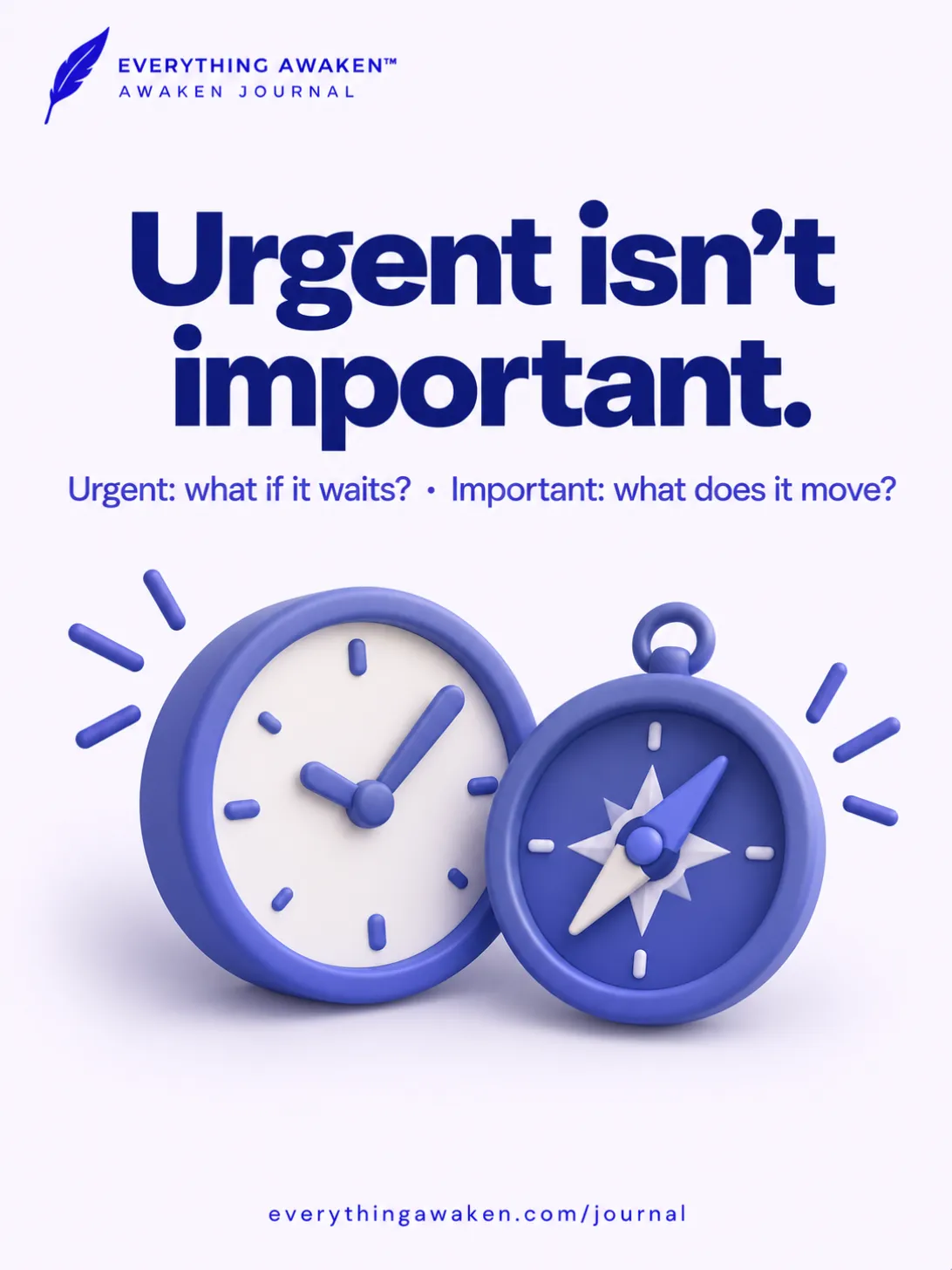
- Urgent: it has a near deadline, or someone is waiting. Ask: what happens if it waits?
- Important: it moves something you care about, like your work, your health, the people close to you, or a goal. Ask: will this matter in a month?
A task can be urgent, important, both or neither. The trouble starts when urgent things are treated as important just because they're loud.
How to prioritise when everything feels urgent: 5 steps
1 · Get it all out of your head
Write every task down, one per line, big and small. It's hard to compare tasks you can't see, and a list on paper or a screen is easier to sort than one that keeps circling in your head.
2 · Ask what really happens if it waits
Go down the list and write one word next to each task: today, this week or later. Be strict. "Someone might be a bit annoyed" isn't the same as "the payment bounces". Many tasks that feel urgent are fine tomorrow.
3 · Ask what it moves
Now mark the tasks that move something you care about. These are your important ones, whether or not they're due soon. Often the most important task on the list has no deadline at all, which is exactly why it keeps getting pushed back.
4 · Pick two or three, and do one first
From the important ones, choose two or three for today. Do one of them first, before the messages and the small jobs. That's the old advice to "eat the frog": do the hardest important thing first, and, as the saying goes, the rest of the day feels lighter.
5 · Put the small urgent things in one slot
Replies, forms and quick calls are real work, but they don't each need to interrupt you. Put them into one short slot, say 30 minutes after lunch, and do them together. Anything that's neither urgent nor important can wait, go to someone else, or be dropped.
The urgent/important grid
Once you've asked both questions, every task lands in one of four boxes:
- Urgent and important: do it now. A real deadline today, with real consequences if it's missed.
- Important, not urgent: decide when you'll do it. Put it in your week before the urgent things fill it. This is the box urgency crowds out first.
- Urgent, not important: batch it, or hand it off. It needs doing, but not by you right now, and not one at a time.
- Neither: drop it, or let it wait. Some tasks are only on the list because they were easy to write down.

When it really is all urgent
Some weeks really are all fires: a big deadline, a sick child, a move. Then:
- Sort by what it costs if it slips. Do the thing with the worst consequences first.
- Tell people early what will be late. A heads-up is easier for everyone than a missed deadline.
- Keep one small important thing anyway. Even 20 minutes on it means the week isn't only other people's fires.
- Protect sleep and meals. They're the first things to go in a week like this, and everything else gets harder without them.
If everything has felt urgent for weeks, and you feel overwhelmed or can't switch off on most days, talk to someone you trust, your manager, or a doctor or therapist. A better list helps with a busy week. It isn't a fix for stress that doesn't let up.
Keeping it where it's easy
You can do all of this on paper. In Awaken Journal, a private journal app by Everything Awaken, the weekly To-Do is built around the same idea:
- Ideas wait in a Brain Dump. Only what you commit to for the week counts.
- What you commit to goes into three kinds: Frog Tasks (the week's most important work), Weekly Goals and Urgent Tasks.
- The week's score weights them on purpose: Frogs share 50 points, Goals 30, Urgent tasks 10, and planning your week earns the last 10. Urgent work still counts, but the important things move your week the most.
- You can have only 2 to 5 Frogs a week (it starts at 4), so "most important" stays a short list.
Read what the To-Do in Awaken Journal is for, how its score is worked out and how its Frog Tasks and the Frog limit work.
Quick answers
How do I prioritise (prioritize) tasks when everything feels urgent?
Ask two questions of each task: what really happens if it waits, and does it move something that matters? Do one important task first, put the small urgent ones in one slot, and let the rest wait.
What's the difference between urgent and important?
Urgent means it has a near deadline or someone is waiting. Important means it moves something you care about. A task can be one, both or neither.
What is the Eisenhower Matrix?
A grid of four boxes: urgent and important (do it now), important but not urgent (plan it), urgent but not important (batch it or hand it off), and neither (drop it). It's named after a line in a 1954 speech by Dwight D. Eisenhower.
Why do urgent tasks feel more important than they are?
In five experiments, people picked tasks with smaller rewards over ones with bigger rewards when the smaller tasks merely looked urgent. The researchers called it the mere urgency effect.
How many priorities should I have in a day?
Few enough that you could finish them all. If your list of "top priorities" runs past five, it's a to-do list, not a priority list.
Where to go next
Picked your few and still putting the big one off? Read Eat the Frog. Head racing with everything you need to do? Try journaling for overthinking. New to journaling? Start with how to start a journal.
Sources
- Zhu, M., Yang, Y., & Hsee, C. K. (2018). The mere urgency effect. Journal of Consumer Research. doi.org/10.1093/jcr/ucy008
- Eisenhower, D. D. (1954, 19 August). Address at the Second Assembly of the World Council of Churches, Evanston, Illinois. The American Presidency Project. presidency.ucsb.edu
- Covey, S. R. (1989). The 7 Habits of Highly Effective People. Free Press.