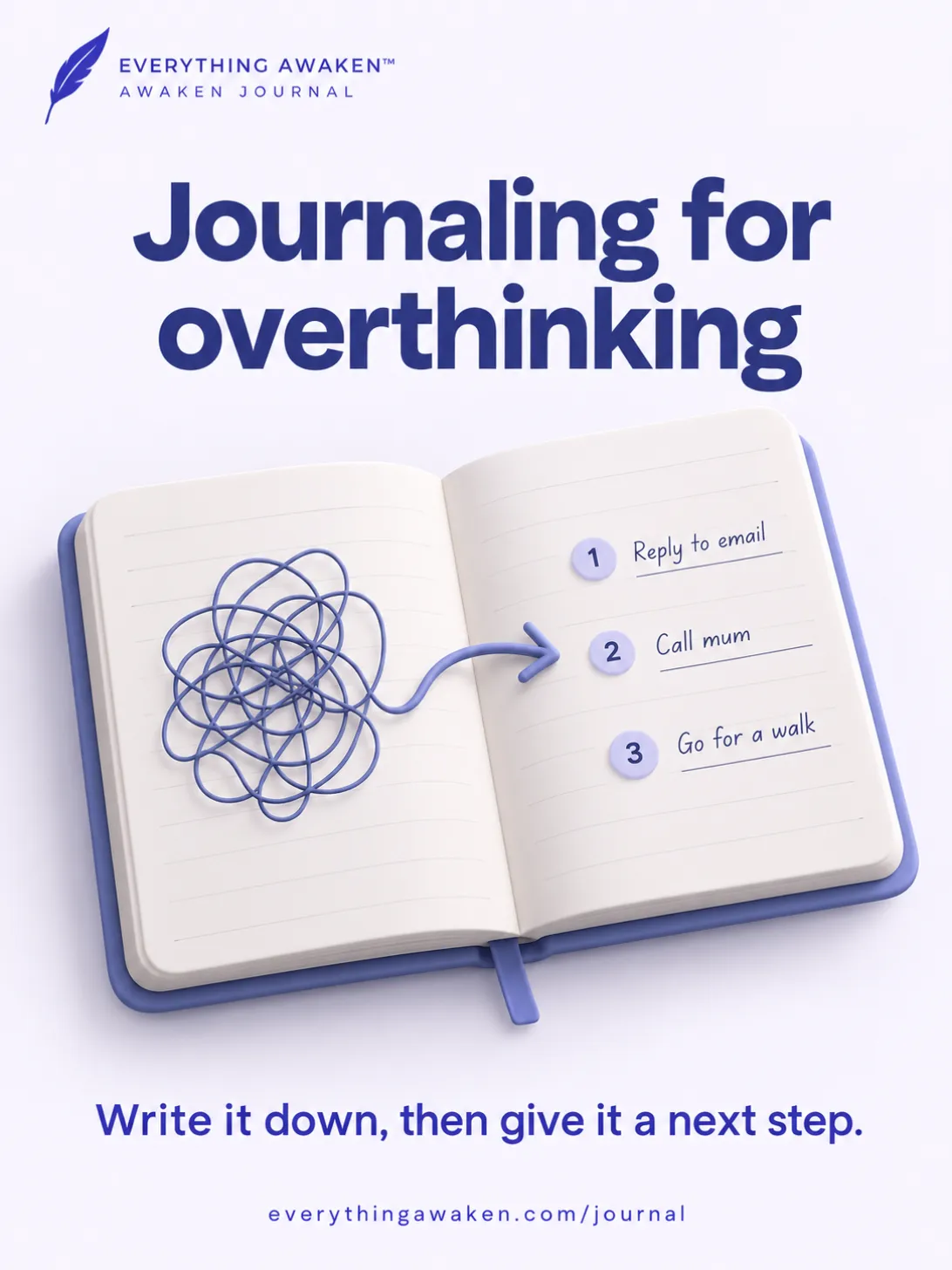
The short answer: write your thoughts down, then do something with each one. Get everything out of your head, give each worry a next step or a time, and stop there. Research on writing and worry points in the same direction: a thought that's been written down and given a plan stops pulling at you. A thought you only write down again and again can keep you stuck. Below is a 10-minute way to do it, what the studies found, and prompts for when your head won't settle.
The 30-second version: write every worry down, give each one a next step or a time, then stop.
Why writing helps a busy mind
Overthinking is mostly unfinished business. Your mind keeps returning to what isn't settled, so it doesn't get forgotten. Writing can tell it that something has been handled, and the studies below show what that looks like.
- A plan quiets an unfinished task. People with an unfinished goal on their mind had more intrusive thoughts and did worse on an unrelated task. When they wrote a specific plan for it, without doing the task, that interference went away (Masicampo & Baumeister, 2011).
- Writing about what's bothering you frees up attention. Students who wrote about a stressful experience reported fewer intrusive thoughts weeks later, and did better on memory tests, than students who wrote about something neutral (Klein & Boals, 2001).
- Ten minutes of writing before a stressful moment can help. Students who spent ten minutes writing about their worries just before an exam scored higher than those who didn't, and the anxious students gained the most (Ramirez & Beilock, 2011).
- Tomorrow's list helps you fall asleep. People who spent five minutes writing a specific to-do list at bedtime fell asleep faster in a sleep lab than people who wrote about what they'd already done (Scullin et al., 2018).
- A set time for worry shrinks it. People who saved their worrying for one 30-minute window a day, at the same time and place, reported less worry, anxiety and sleep trouble after two weeks than a comparison group (McGowan & Behar, 2013).
One honest caveat: across 146 experiments, the average benefit of this kind of writing is real but small (Frattaroli, 2006). It helps some people a lot and others very little. Journaling isn't a cure, but it's a cheap, private habit worth trying.
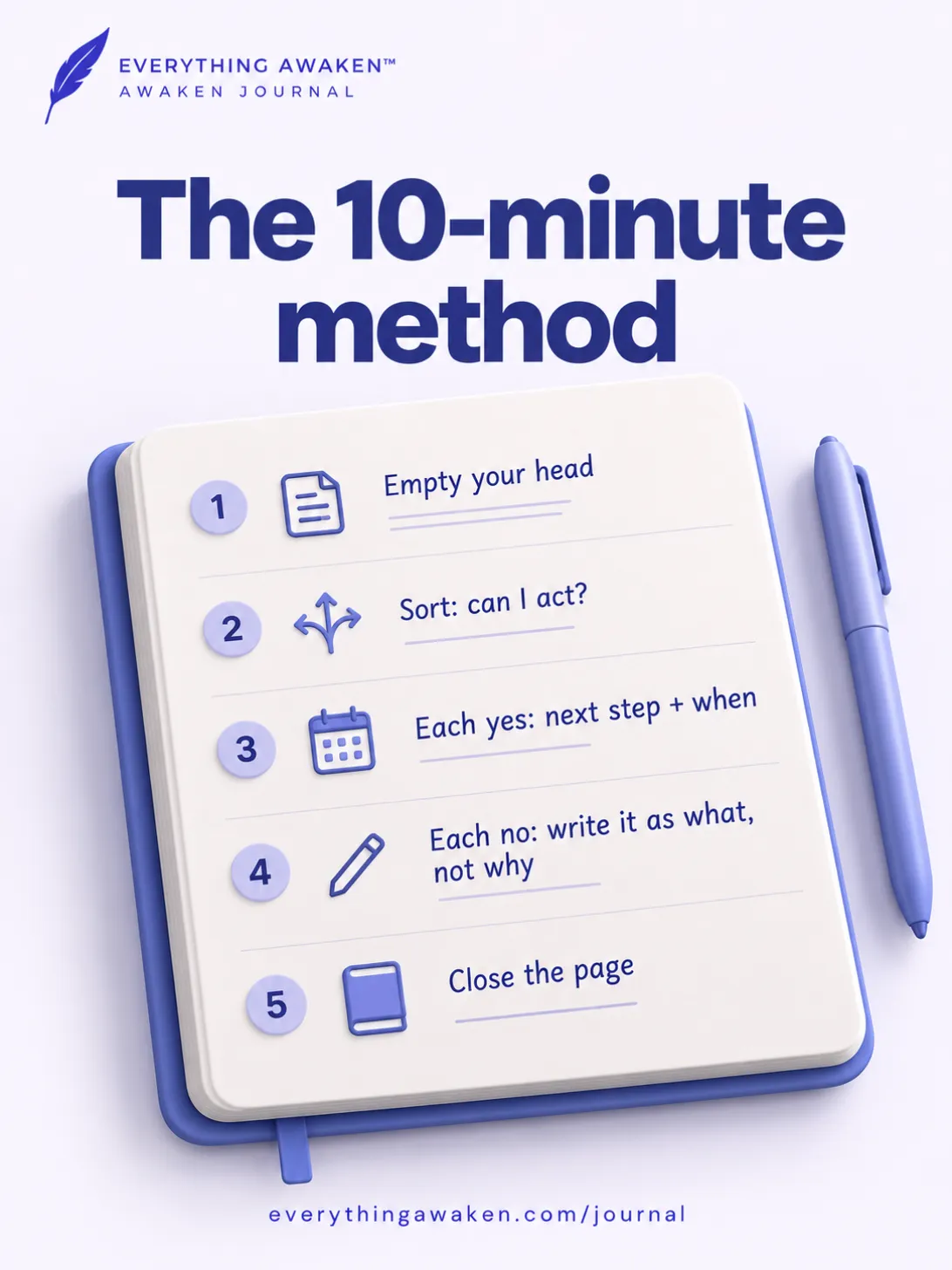
The 10-minute method
1 · Empty your head (3 minutes)
Write down everything that's on your mind, one line each. Big, small, silly, serious. Don't sort and don't explain. If it's taking up space in your head, it goes on the page.
2 · Sort it into two piles (1 minute)
Next to each line, mark it: can I do something about this? Yes or no. Most lists turn out shorter and more ordinary on paper than they felt in your head.
3 · Give every "yes" a next step (3 minutes)
For each one, write the smallest next action and when you'll do it: "Email Priya on Thursday morning", not "sort out the project". This is the part the research keeps pointing at. A specific plan is what lets your mind put it down, even before it's done.
4 · Write every "no" concretely (2 minutes)
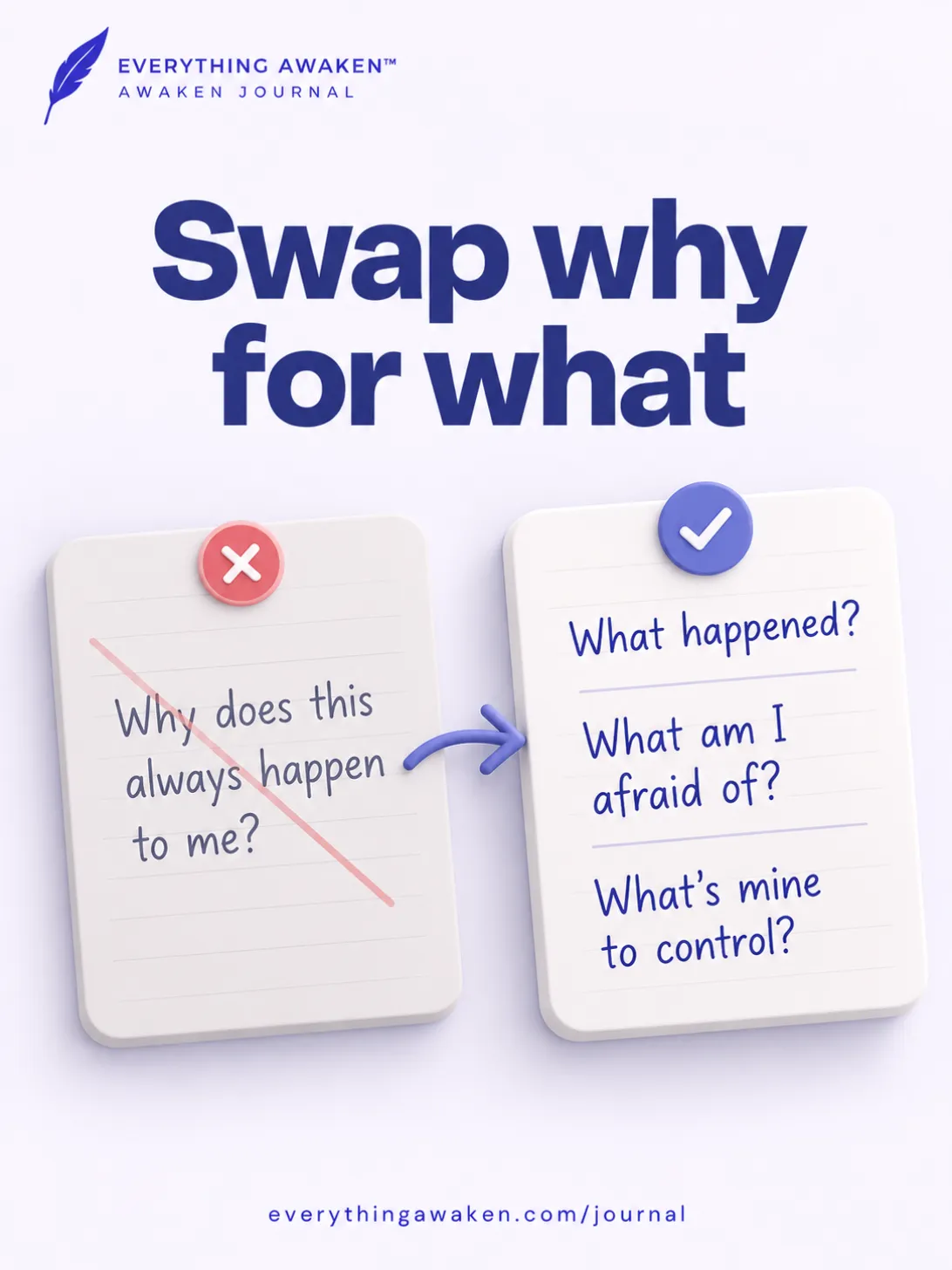
For worries you can't act on, swap "why" for "what". Not why does this always happen to me, but what exactly happened, what am I afraid will happen next, and what part of it is mine to control. Concrete, step-by-step thinking tends to help people solve problems, while abstract "why" questions tend to keep a low mood going (Watkins, 2008).
5 · Close it (1 minute)
Write one line to end: what you'll do first tomorrow, or simply "done for today". Then stop. If a worry comes back later, you don't need to think it through again. You can tell yourself it's already on the page.
Give worry a time slot
If thoughts keep coming back all day, try a worry window: 15 to 30 minutes at the same time each day, in the same place, and not right before bed.
When a worry shows up outside the window, write it in one line and leave it for later. When the window comes, read the list. Some of it will already feel smaller. Work through the rest with the method above.
The kind of journaling that doesn't help
Writing the same worry over and over, in the same words, asking the same "why", isn't processing. It's overthinking on paper. Signs you've slipped into it:
- You're on your third page about one thing and nothing new has appeared.
- Every sentence is a question, and none of them has an answer.
- You feel worse at the end than at the start, every time.
When that happens, stop and switch to step 3 or 4: one next step, or one concrete sentence. In one study of students prone to low mood, writing about their thoughts and feelings for three short sessions lowered depressive symptoms six months later, and it worked by reducing brooding, that same stuck, repetitive loop (Gortner, Rude & Pennebaker, 2006). The aim of writing is to get out of the loop, not to rehearse it.
Journal prompts for overthinking
- What's on my mind right now? List everything, one line each.
- Which of these can I do something about this week?
- What's the smallest next step, and when will I take it?
- What exactly am I afraid will happen?
- What's the most likely thing to happen instead?
- What part of this is in my control, and what isn't?
- What would I tell a friend who was worrying about this?
- What have I already done about this today?
- If I let this go until tomorrow, what's the worst that happens?
- What's one thing I'll do first tomorrow morning?
For more, 100 journal prompts sorted by what you need today has whole groups for a full head and for worry.
Keeping it where you can find it
Two things make this easier to keep up: writing a thought down the moment it shows up, and being able to look back later and see what actually happened.
In Awaken Journal, a private journal app by Everything Awaken, Briefs is built for the first one. You type one line, press Enter, and it's saved with the exact time, then you're back to what you were doing. It works as a worry list during the day, and as a record of when your mind got busy. Thoughts is an open page for the longer version, the 10-minute method above. Each thought you save there is also collected, day by day, into one note for the whole month, so at the end of the month you can read every worry, plan and "done for today" in one place and see which ones mattered. Everything is encrypted on your device, so nobody else can read it, us included. Our Guide shows how to start a digital journal, your first day done small. A paper notebook works just as well for the method itself.
When it's more than overthinking
Journaling is a way to notice what's going on, and it isn't treatment. If racing thoughts are stopping you from sleeping, working or enjoying things for more than a couple of weeks, or if writing brings up something that feels too heavy to hold alone, talk to a doctor, a therapist or someone you trust. Constant worry can be part of anxiety or depression, and both are very treatable.
Quick answers
Does journaling help with overthinking?
It can. Studies found that writing down worries, and especially writing a specific plan for unfinished tasks, reduced intrusive thoughts, and that writing tomorrow's to-do list at bedtime helped people fall asleep faster. The average effect is modest, so treat it as a useful habit rather than a cure.
How do I journal to stop overthinking?
Write everything on your mind, one line each. Mark what you can act on. Give each of those a next step and a time. Write the rest concretely: what happened, what you fear, what's in your control. Then close the page.
What should I write when my mind won't stop?
Start with a list of everything that's on it, without sorting. Then ask: which of these can I do something about this week, and what's the smallest next step?
Can journaling make overthinking worse?
Yes, if you write the same worry over and over without moving it forward. If you feel worse every time, switch to one concrete next step, or take a break and talk to someone.
How long should I journal for overthinking?
About 10 minutes is enough for the method above. Many people do it in the evening, or use a set daily "worry window" of 15 to 30 minutes.
Where to go next
New to journaling? Read how to start a journal and keep it going past week two. Need a question to start with? Try 100 journal prompts, sorted by what you need today.
Sources
- Masicampo, E. J., & Baumeister, R. F. (2011). Consider it done! Plan making can eliminate the cognitive effects of unfulfilled goals. Journal of Personality and Social Psychology. doi.org/10.1037/a0024192
- Klein, K., & Boals, A. (2001). Expressive writing can increase working memory capacity. Journal of Experimental Psychology: General. doi.org/10.1037/0096-3445.130.3.520
- Ramirez, G., & Beilock, S. L. (2011). Writing about testing worries boosts exam performance in the classroom. Science. doi.org/10.1126/science.1199427
- Scullin, M. K., Krueger, M. L., Ballard, H. K., Pruett, N., & Bliwise, D. L. (2018). The effects of bedtime writing on difficulty falling asleep. Journal of Experimental Psychology: General. doi.org/10.1037/xge0000374
- McGowan, S. K., & Behar, E. (2013). A preliminary investigation of stimulus control training for worry. Behavior Modification. doi.org/10.1177/0145445512455661
- Gortner, E.-M., Rude, S. S., & Pennebaker, J. W. (2006). Benefits of expressive writing in lowering rumination and depressive symptoms. Behavior Therapy. doi.org/10.1016/j.beth.2006.01.004
- Frattaroli, J. (2006). Experimental disclosure and its moderators: A meta-analysis. Psychological Bulletin. doi.org/10.1037/0033-2909.132.6.823
- Watkins, E. R. (2008). Constructive and unconstructive repetitive thought. Psychological Bulletin. doi.org/10.1037/0033-2909.134.2.163