The short answer: write one true line about today, even if the day was ordinary. "Nothing to say" usually means "nothing big happened", and a journal doesn't need big. Write what you did, one thing you noticed, or one thing that went fine, and stop there if you want to. Ordinary days are the easiest to forget, and in a set of studies people enjoyed rediscovering their records of everyday moments more than they expected to. Below are seven easy ways in, 20 prompts for empty days, and how to keep going when you really don't feel like it.
The 30-second version: write one true line about today. The ordinary days are the ones you'll be glad to find later.
Why the page feels empty
Three things usually sit behind "I have nothing to say":
- You think it has to be important. A journal isn't a highlights reel. If you only write when something big happens, most days won't seem to qualify.
- The blank page asks too much. "Write about your day" is a huge question. A small, specific one is much easier to answer.
- You're tired. At the end of a long day, finding something meaningful to say is work. Writing down what happened isn't.
All three have the same fix: make the question smaller.
The boring days are worth keeping
It's easy to think an ordinary Tuesday isn't worth writing down, because you'll remember it anyway. You probably won't.
In four studies, people recorded everyday experiences and guessed how curious and interested they'd be to rediscover them later. They underestimated it, and they underestimated it most for ordinary, everyday moments rather than special ones (Zhang et al., 2014). The researchers linked this to our misplaced faith in remembering everyday life.
So the line that feels too dull to write, "Made pasta, watched the rain, called Mum", may be the one you're glad to find later.
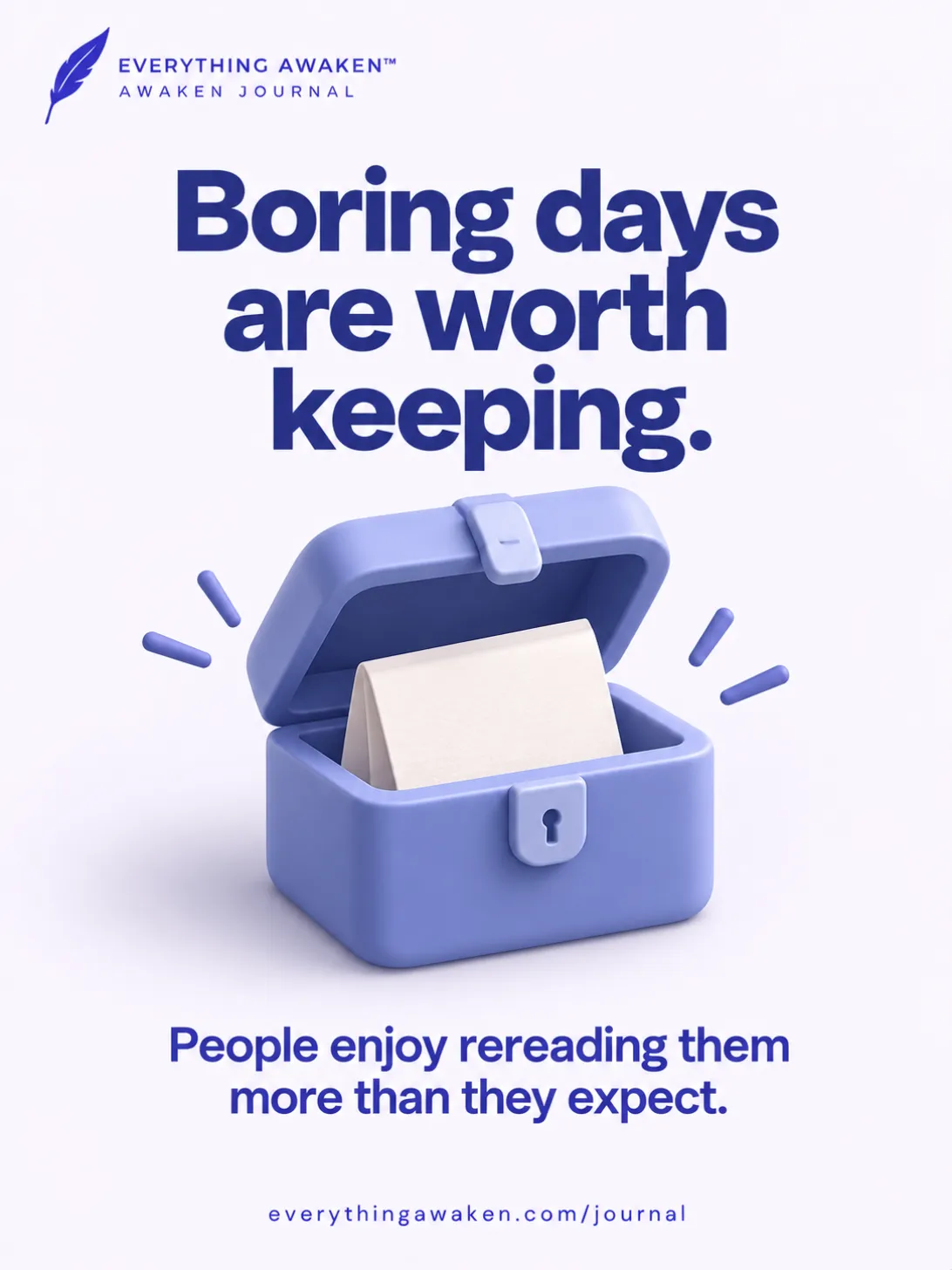
7 easy ways in when you have nothing to say
1 · Write one line about today
One sentence about the day as it was. Not how it should have gone, not what it meant. "Slow day. Finished the report, walked to the market, early night." That's a full entry.
2 · List what you did, in order
Morning, afternoon, evening: three short lines. It's a to-do list in reverse, and it's often where something worth saying turns up, like the conversation you'd already forgotten, or the small thing that annoyed you more than it should have.
3 · Use your senses
One thing you saw, one you heard, one you tasted. "The smell of rain on the balcony." Small physical details are the easiest things to write, and the ones that bring a day back when you reread it.
4 · Write three things that went well
They don't have to be big: the bus came on time, lunch was good, a friend replied. In one study, people who regularly listed things they were grateful for, instead of hassles, ended up in a better mood, though not every measure improved (Emmons & McCullough, 2003). In an online study that tested five happiness exercises against a placebo, writing down three things that went well each day, and why, for one week was among the exercises with lasting effects on happiness and symptoms of depression (Seligman et al., 2005).
5 · Write what's on your mind
Sometimes "nothing to say" really means "nothing I want to say". If something has been sitting at the back of your head, write one line about it. You don't have to solve it. If your mind is busy rather than empty, journaling for overthinking has a 10-minute method for that.
6 · Answer one question
Pick one question and answer it in two lines. The list below is built for empty days, and 100 journal prompts, sorted by what you need today, has plenty more.
7 · Write about tomorrow
If today really was empty, look ahead: one thing you're looking forward to, one thing you'll do first, one thing you'd like to go differently.
And if none of these works, write "Nothing much today" with the date. That still counts. A run of "nothing much" days is worth noticing in itself.
Keep it small enough for your worst day
On an empty day, the aim isn't a good entry. It's keeping the habit alive with as little effort as possible.
- Make one line the minimum. If one line counts, you'll write on days when a full page would have felt impossible. On good days you'll write more without trying.
- Tie it to something you already do. "After I brush my teeth at night, I write one line." Research on plans in this "when X happens, I'll do Y" form finds they help people turn intentions into action (Gollwitzer, 1999).
- Missing a day doesn't undo it. In a study of how habits form, people repeated one daily behaviour in the same situation for 12 weeks. How long it took to feel automatic varied hugely, from 18 to 254 days, and missing a single day didn't materially affect the process (Lally et al., 2010). A skipped day is just a skipped day. Write one line tomorrow.
One honest caveat: most research on writing looks at specific exercises, not everyday diary-keeping, and across 146 experiments the average benefit of writing about your experiences is real but small (Frattaroli, 2006). Keep a journal because it's useful to you, not because it promises to change your life.
20 prompts for days when you have nothing to say
- What did I do today, morning to night, in three lines?
- What's one thing I noticed today that I'd usually ignore?
- What did I eat today that I enjoyed?
- Who did I talk to, and what about?
- What made me smile, even a little?
- What was the most ordinary moment of my day?
- What's one thing that went fine?
- What did I hear today: a song, a sound, a sentence?
- What took longer than I expected?
- What am I a little bit annoyed about?
- What's one thing I learned or read?
- What was the weather like, and did it change my day?
- What am I looking forward to this week?
- What's one thing about today I'd like to remember?
- What did I do for my body today: a walk, rest, a good meal?
- What's one small thing I'd do differently?
- Who has been on my mind lately?
- What's one thing I'll do first tomorrow?
- What would I tell a friend about my day in one sentence?
- If today were one word, what would it be, and why?
Keeping it where it's easy
A journal that asks for less makes empty days easier. In Awaken Journal, a private journal app by Everything Awaken, each day's page is split into small sections: Gratitude, Briefs, Learning and Thoughts to start with. So you answer small questions instead of facing one blank page, and you can hide the sections you don't use or add your own. Briefs takes one line at a time: type it, press Enter, and it's saved with the exact time.
There's no word count anywhere, and the Journal Score counts the days you wrote, not how much you wrote, so one line on an empty day counts the same as a full page. Everything is encrypted on your device, so nobody else can read it, us included. A paper notebook works just as well for everything above.
When every day feels empty
Most "nothing to say" days are just quiet days. But if you've felt flat, numb or uninterested in things you usually enjoy for more than a couple of weeks, talk to a doctor, a therapist or someone you trust. Low mood is common and very treatable. A journal can help you notice it, but it isn't treatment.
Quick answers
What should I write in my journal when nothing happened?
Write one line about the day as it was: what you did, one thing you noticed, or one thing that went fine. Ordinary days are the easiest to forget, so they're worth a line.
Is it okay to write just one sentence in a journal?
Yes. One sentence keeps the habit going on days when more would feel like too much, and you'll write more on the days you feel like it.
What do I write if I don't feel like journaling?
Write "Not in the mood today" and one reason, or one thing you're looking forward to. It takes 30 seconds and still counts.
Does it matter if I skip a day?
Not much. In a study of how habits form, missing a single day didn't materially affect the process. Write one line the next day.
How do I make journaling a habit?
Keep the minimum tiny, one line, and tie it to something you already do every day, like brushing your teeth at night.
Where to go next
New to journaling? Read how to start a journal and keep it going past week two. Need more questions? Try 100 journal prompts, sorted by what you need today.
Sources
- Zhang, T., Kim, T., Brooks, A. W., Gino, F., & Norton, M. I. (2014). A "present" for the future: The unexpected value of rediscovery. Psychological Science. doi.org/10.1177/0956797614542274
- Emmons, R. A., & McCullough, M. E. (2003). Counting blessings versus burdens: An experimental investigation of gratitude and subjective well-being in daily life. Journal of Personality and Social Psychology. doi.org/10.1037/0022-3514.84.2.377
- Seligman, M. E. P., Steen, T. A., Park, N., & Peterson, C. (2005). Positive psychology progress: Empirical validation of interventions. American Psychologist. doi.org/10.1037/0003-066X.60.5.410
- Gollwitzer, P. M. (1999). Implementation intentions: Strong effects of simple plans. American Psychologist. doi.org/10.1037/0003-066X.54.7.493
- Lally, P., van Jaarsveld, C. H. M., Potts, H. W. W., & Wardle, J. (2010). How are habits formed: Modelling habit formation in the real world. European Journal of Social Psychology. doi.org/10.1002/ejsp.674
- Frattaroli, J. (2006). Experimental disclosure and its moderators: A meta-analysis. Psychological Bulletin. doi.org/10.1037/0033-2909.132.6.823